CHRONOLOGICAL COLLECTION CATALOGUE
|
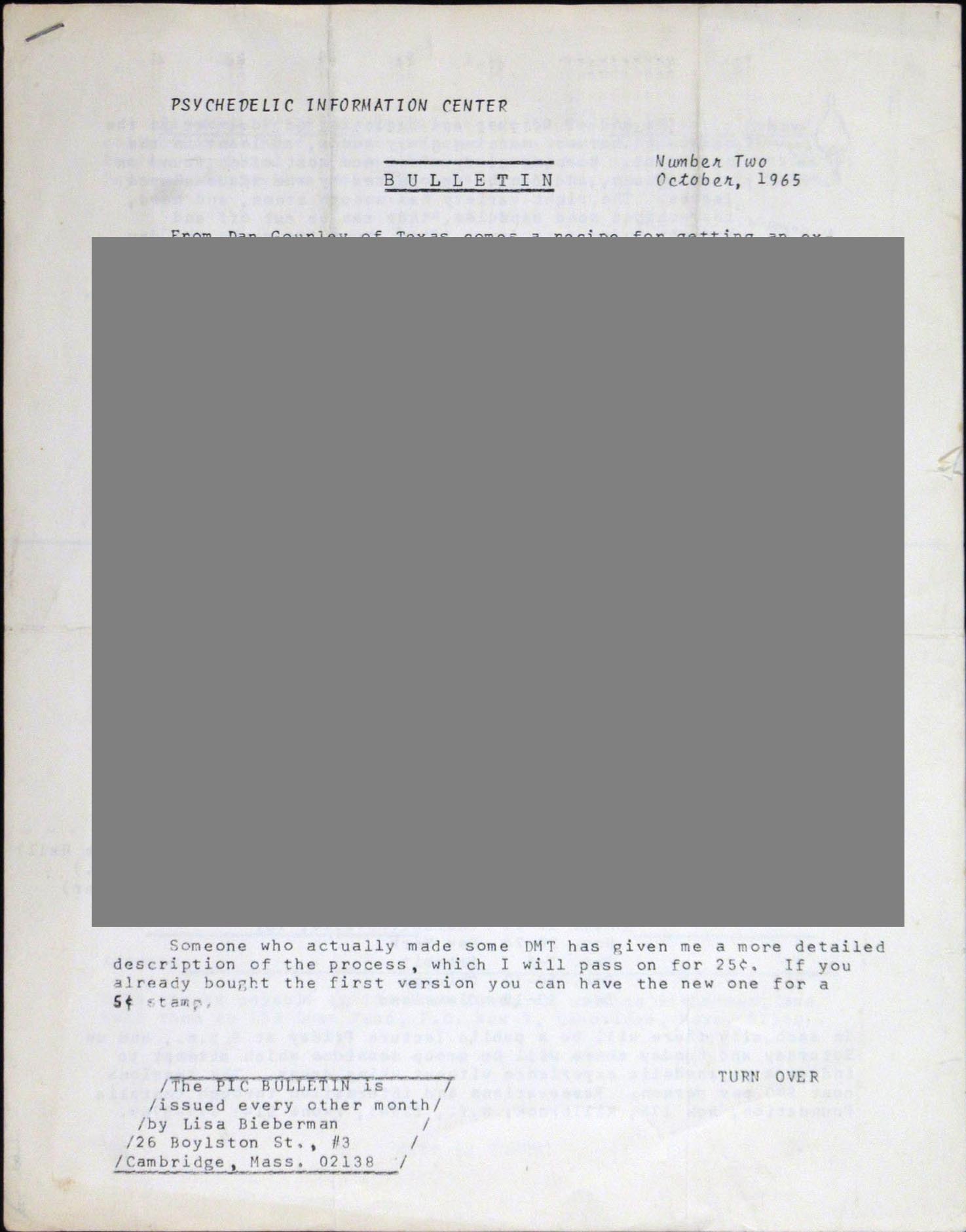
1965.10.001 Handbill: “Psychedelic Information CenterBULLETIN No. 2October 1965Lisa Bierberman”
This issue focuses on the preparation of various psychedelics, the schedule for a lecture tour of Timothy Leary and Ralph Metzner, and the formation of “the LSD LOAN FUND” to have a standing fund to aid active projects aimed at making psychedelic drugs available to individuals for religious or philosophical purposes.In the fall of 1966 Lisa Bieberman, one of Timothy Leary’s followers, started publishing a more-or-less bi-monthly “Psychedelic Information Center BULLETIN.” The early issues focused primarily on various recipes to prepare psychedelic agents from various plants. The later issues espouse conclusions about drug use (“marijuana inflates one’s self-conceit; but LSD undermines it.”), the status of various laws and legal cases concerning drug usage and possession, the results of clinical trials of psychotropic agents, the psychological repercussions of using LSD (flashbacks), the physiological repercussions of using LSD (chromosome damage), the religious use of LSD, and in the final issue, 5 years later, Lisa’s realization that she did not understand LSD and that she did not plan to “take psychedelics any more because I am afraid of them.”
|
|
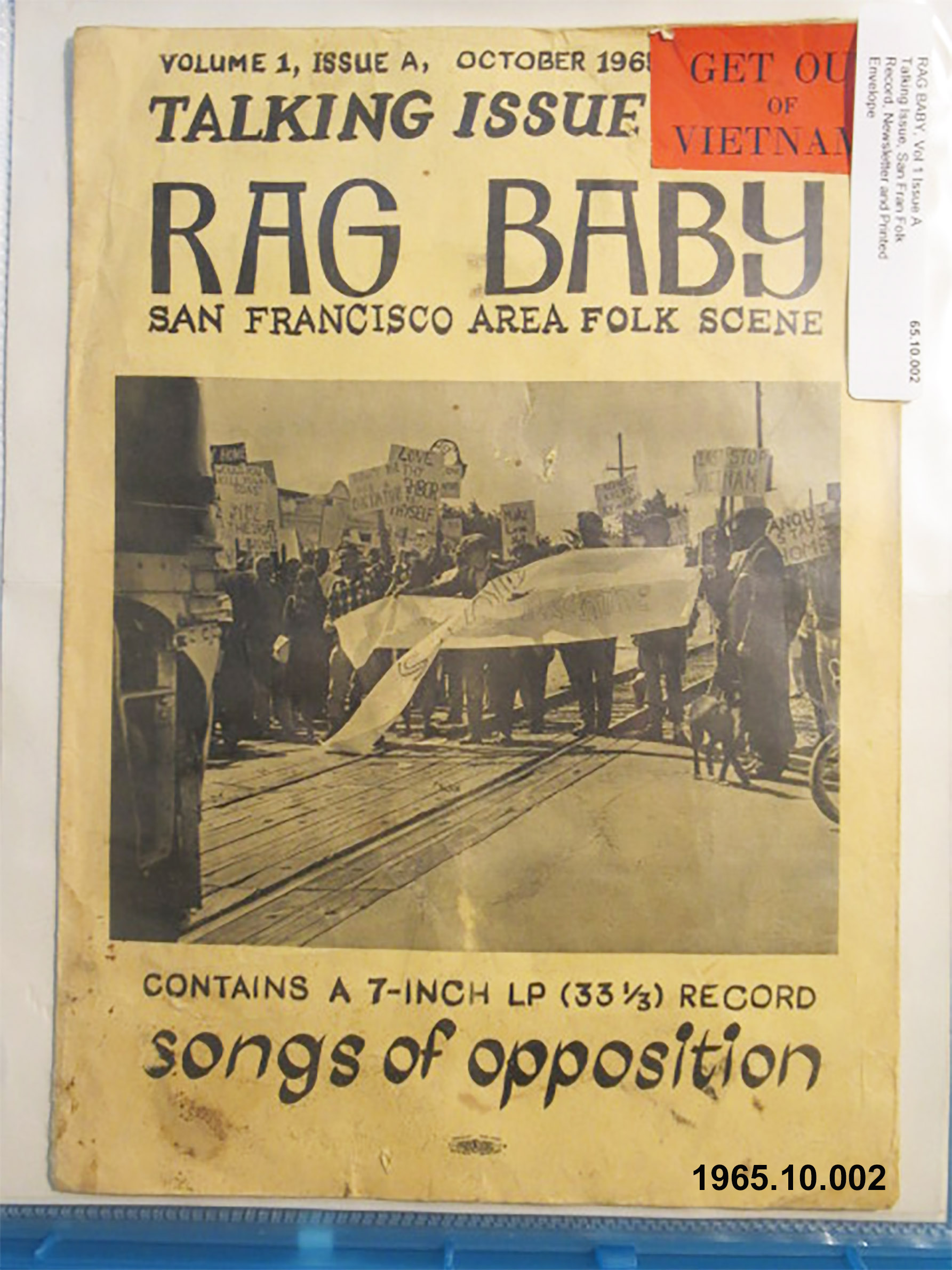
1965.10.002 R + SleeveHandbill: “RAG BABY, Vol 1 Issue ATalking Issue, San Fran Folk Record, Newsletter and Printed Envelope”
Music, specifically rock music, was also coming into it’s own in 1965 and far more importantly than poetry or protest, it was in the San Francisco Bay area rock music bands that conveyed the hippies message of social change and societal liberation. “Country” Joe McDonald was a publisher of the left-wing underground magazine Et Tu Brute, which later became Rag Baby, containing poetry, drawings, and political messages. By early 1965, McDonald had become involved in the burgeoning folk scene in Berkeley, and the Free Speech Movement that was organizing demonstrations in University of California, Berkeley, which opposed the war in Vietnam. Not long afterwards, McDonald was inspired to record a "talking issue" of his magazine, and organized Country Joe and the Fish with Melton and fellow musicians Carl Schrager (washboard, kazoo), Bill Steele (bass guitar), and Mike Beardslee (vocals), out of both necessity of a recording alias and political device, to self-produce an extended play.ED Denson, the co-publisher of Rag Baby, introduced McDonald to Chris Strachwitz, who owned Arhoolie Recording Studios, to self-produce the EP. Sensing the band's potential, Denson assumed management control, and was responsible for coining the group's name—a reference to Josef Stalin and to Mao Zedong's description of revolutionaries as "the fish who swim in the sea of the people".[2] McDonald, who had recording experience, began utilizing Arhoolie Recording Studios to record four songs split equally between the band and a local folk musician, Peter Krug. It was during this time at Arhoolie Records that Country Joe and the Fish's folk sound and political protest prowess—an amalgam of their own Guthrie-influenced material and their folk music roots—began to emerge. The band's side of the EP featured two originals by McDonald, an acoustic version of "I Feel Like I'm Fixin' to Die Rag", and "Superbird".[5][8] According to McDonald, "The Fish Cheer" was written in 30 minutes, with a purpose of expressing satiric and dark commentary on the US's involvement in the Vietnam War. In October 1965, 100 copies of the EP, titled Rag Baby Talking Issue No. 1, were distributed on McDonald's independent label at a Teach-in in UC Berkeley and underground shops selling Rag Baby magazine.The copy you see here, is one of those 100 copies.
|